|
Hai-Bar
National Park
|
||||||||||||
 |
||||||||||||
|
|
||||||||||||
|
||||||||||||
|
||||||||||||
|
updated:
28.12.02 18:32
|
||||||||||||
|
Hai-Bar
National Park
|
||||||||||||
|
|
||||||||||||
|
|
||||||||||||
|
||||||||||||
|
||||||||||||
|
updated:
28.12.02 18:32
|
||||||||||||
|
Hai-Bar Yotvata is a unique project to
restore endangered animals to Israel's landscape, remember it is not
a zoo. |

| Hai-Bar Yotvata is located in the Yotvata Reserve, 40 kilometers north of Eilat on the 'Arava road (no. 90), between Kibbuz Yotvata in the north and Kibbuz Samar in the south. |
| At the turn of the century, when people began to hunt
wild animals with live ammunition, entire animal populations shrunk dramatically,
and some even became extinct. Animals that disappeared from the desert
landscape include the Arabian oryx, the onager and the ostrich. This adversely
affected predators, such as wolves, and populations of carcass-eating
birds and their numbers subsequently shrunk. In the 1960s, Uri Tzon and Avraham Yoffe organised "Hai-Bar," a public organisation. Tzon and Yoffe had two objectives: to rehabilitate populations of wild animals that had become extinct and to bolster endangered populations. Later, the Nature Reserves Authority assumed responsibility for the Hai-Bar. In 1964, the area of the Hai-Bar was fenced in ("the open area") and the Nature Reserves Authority introduced desert birds and ungulates, some of which are mentioned in the Bible. These animals included the onager, the African ass, the oryx, and the ostrich. The Hai- Bar was opened to the public in 1977. In 1986, the Predators Center was established. Desert animals typical to Israel, including mammals, birds of prey, and reptiles, are bred and exhibited at the center. The 'Desert Night Life Exhibition Hall', where visitors can observe small nocturnal desert animals, opened its doors a few years later. In the open area of the Hai-Bar, the staff prepares desert animals for their reintroduction to nature. The animals are propagated and marked, and their genetic make-up, health, and social status are studied. Based on these findings, the staff chooses which individuals will make up the herd, which will be restored, to nature. The selected animals are placed in acclimation pens in the reintroduction area until their release. |
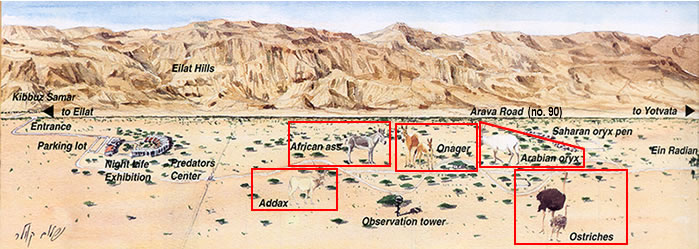
| The African wild ass (Equus africanus) is gray with black stripes on its legs. Mentioned in the Bible along with the onager as an animal that can be domesticated, the African ass is the forefather of the domestic asses. This species is extremely rare both in nature and in captivity. Because of the small population of African asses in the Hai-Bar, as well as the numerous difficulties involved in propagating the species in captivity and the possibility that this species will mate with domestic asses, the African ass will not be restored to the Negev. |
| The Predators Center houses representatives of three
families of predators: canines, felines and hyenas. There are a number of canines at the center. Blanford's fox (Vulpes cana) lives on the cliffs and rocks and was first discovered in Israel in the early 1980s; apparently the sand fox (Vulpes rueppelft) used to primarily inhabit the sand dunes. Visitors can also observe the smallest canine in the world, the fennec (Fennecus zerda), with huge ears that help it cool its body in the desert heat, and the largest canine in Israel, the wolf (Canis lupus). Smaller felines include the sand cat (Felis margarita), which lives in sand dunes. The sand cats colour serves as camouflage and its legs have characteristic striping. Visitors to the center can also observe the wild cat (Felis silvestris), a species which is jeopardised by interbreeding with domesticated cats. Larger cats include the caracal (Felis caracal), identified by its tufted ears, and the leopard (Panthera pardus), which ambushes rock hyrax and ibex. The Predators Center also has a striped hyena (Hyaen hyaena), which loves to eat carcasses and serves as nature's land- based sanitation engineer. The center is also home to lizards, agamas, and most species of desert snakes, rodents, and nocturnal and diurnal birds of prey, including carcass-eaters. The Predators Center was designed to meet three goals: the reproduction of rare predators, research in conditions of captivity, and visitor education. In a large cage at the Predators Center, visitors can observe two of the four carcass-eaters in Israel: the smallest vulture, the white and black Egyptian vulture (Neophron percnopterus), which uses its thin beak to glean small pieces of meat from the carcass; and the larger lappet-faced vulture (Torgos tracheliotus). The lappet-faced vulture is the only animal in the Predators Center today which had disappeared from Israel, and there are plans to restore this species to the 'Arava region. |
| Most desert animals are active at primarily at night. Because of this, persons who visit the desert during the day will probably not encounter the local animals. 'The Desert Night Life Exhibition Hall' reverses night and day. During the day, the conditions simulate nighttime, with low temperatures, high humidity, and special lighting which evokes the feeling of gentle moonlight. As a result, visitors can observe desert animals when they are active. A wide variety of animals are represented in the hall: insectivorous animals, such as the desert hedgehog (Paraechinus aethiopicus), which moves quickly along the ground, rodents, including the garden dormouse (Eliomys quercinus melanurus), which often rests on tree trunks, bats, such as Egyptian fruit bat (Rousettus aegyptiacus), which flies over small nocturnal birds of prey, reptiles; and arthropods, such as scorpions and beetles. |
| The Hai-Bar offers a 45-minute guided tour through the open area in an air- conditioned bus. The tour is given in Hebrew and English; tours in other languages can be arranged in advance, The group meets near the Predators Center, then passes through the turnstile designed to keep the animals in. Members of the tour might have an opportunity to observe territorial ostriches, which congregate near the fence, especially during mating season (generally December to March). Visitors proceed to the feeding area near the research tower (no climbing the tower), where they will see white addaxes with their twisted spiral horns and brown onagers. After stopping at the pens where the young ostriches are raise' and at the area where the ostriches are fed, visitors continue on to another feeding area where they encounter straight-horned Arabian oryx and more onagers. Ostriches roam throughout the area; the males are black and the females gray. With every "suspicious" movement, the timid gray African asses take off to the east, leaving behind a cloud of dust. Some groups will encounter the small herbivorous dorcas gazelle, the "shiest" of the lot. The group returns to the Predators Center via a ring road, and gets off the bus for an hour long tour of the Predators Center. In the circular predator's tunnel, visitors will have the opportunity to observe predators, rodents, birds of prey, and reptiles. The group then makes its way to the 'Desert Night Life' Exhibition Hall. After a short 5-7 minutes introduction in the orientation room (for groups of up to 15-20 people), the visitors quietly enter the hall to spend about 15 minutes looking at the different animals. |
| The onager (Equus hemionus) is a brown Asian wild ass. The onager was the first animal to be reintroduced to the Negev; this process was divided into several stages. In the summer, onagers can be spotted congregating around water sources in Makhtesh Ramon and Nahal Paran. During the winter they disperse over a very large area. The process of reintroducing the onagers to Israel is nearing completion. |
| A herbivorous antelope, the Arabian oryx (Oryx /eucoryx) has white fur and straight, sharp horns. It is especially well adapted to the harsh desert conditions. The social structure of the Arabian oryx includes herds of males and females, which travel great distances in search of food and water. Plans call for returning the Arabian oryx to the Negev in 1996-7. |
| The 2.5-meter-tall ostrich (Struthio came/us came/us) is the largest bird alive today. An adult male can weigh up to 150 kilograms. In the mating season, visitors can observe the males, with their black and white feathers and red legs and neck, rhythmically moving their bodies to attract the attention of the gray-feathered females. The Hai-Bar staff has plans for returning the ostrich to the Negev in the future. |
| The scimitar horned oryx (Oryx dammah) and addax (Aqdax nasomaculatus) are from the region of the Sahara desert. Since their area of distribution did not include Israel, they will not be restored to nature in Israel. The scimitar horned oryx and addax are at the Hai- Bar because they are in danger of extinction in their natural environment. |
